
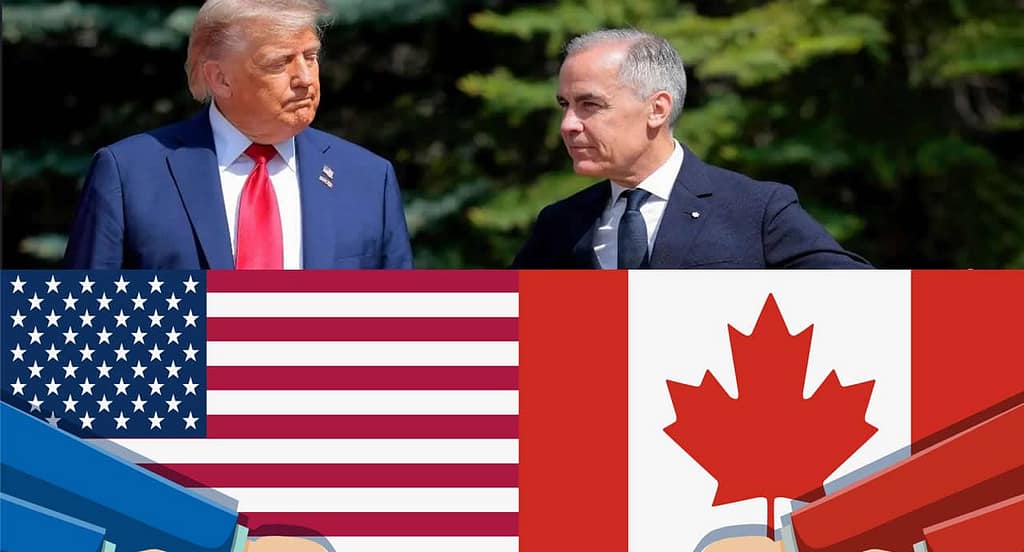
U.S. President Donald Trump announced an additional 10 percent tariff on Canada on Saturday because the Ontario government failed to immediately remove an anti-tariff ad it was running in U.S. markets.
“Because of their serious misrepresentation of the facts, and hostile act, I am increasing the Tariff on Canada by 10 per cent over and above what they are paying now,” Trump made a post on Truth Social, which is his social media platform.
“Their Advertisement was to be taken down, IMMEDIATELY, but they let it run last night during the World Series, knowing that it was a FRAUD,” Trump declared on the platform while traveling aboard Air Force One to Malaysia.
Earlier this month, the Ontario government began a $75-million anti-tariff advertising campaign with ex-U.S. President Ronald Reagan, which was intended to run until the end of January.
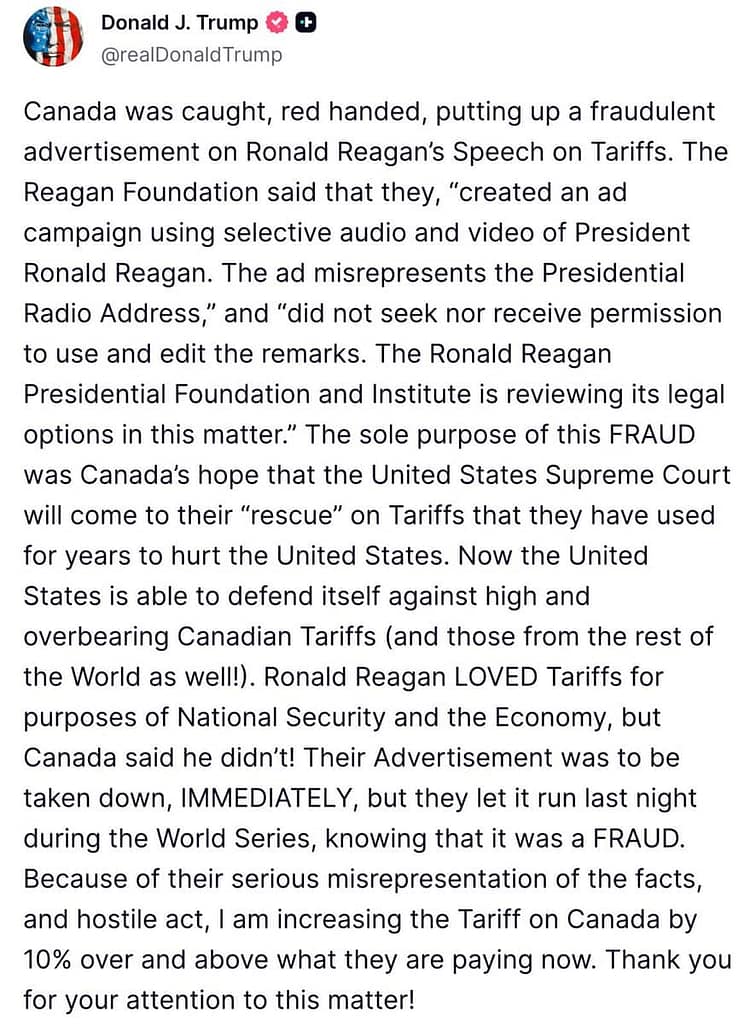
On Thursday night, Trump announced his intention to end trade talks with Canada because of the ad, and Ontario premier Doug Ford announced on Friday that the government would pull the ad in the hope of resuming trade talks, but not until Monday.
After speaking with Carney, Ford announced his decision to pull the campaign. However, the premier also stated that they would only suspend the ads after the weekend in order to play during the first two World Series games and get in front of a huge American audience.
After Trump announced the new 10-percent levy, an email was sent by a Ford spokesperson to confirm that the premier’s statement from Friday is still valid.
Carney is already present in Malaysia for the ASEAN summit, but Trump and Carney are not planning to meet or speak during the summit. Trump stated to reporters traveling with him that he had no plans to meet with Carney in Malaysia.
Carney posed on the tarmac outside Ottawa’s airport Friday morning before departing for Asia, explaining that Canada cannot control a U.S. trade policy that has ‘fundamentally changed’. He stated that his officials and colleagues have been collaborating with americans to conduct constructive and detailed negotiations on sector-specific tariffs, including steel, aluminum, and energy, and that there has been significant progress.
In a social media post on Saturday, Canadian-U.S. Trade Minister Dominic LeBlanc repeated the statement, but avoided directly mentioning Trump’s latest tariff threat or the advertisement.
He stated that Canada stands “ready to build on the progress made in constructive discussions with American counterparts over the course of recent weeks.”
“And that progress is best achieved through direct engagement with the U.S. administration — which is the responsibility of the federal government,” Leblanc made a subtle point in the post on X that the ad did not come from the federal government.
Pierre Poilievre, the Conservative Leader, claimed on social media that Canada wouldn’t have been faced with the tariff hike if Carney had kept his promise to negotiate a win.
Talks between Canadian officials and Trump have been ongoing for almost a year, but appear to have been more concentrated and successful in recent weeks, following the second meeting between Carney and Trump in the Oval Office on Oct. 7.
LeBlanc and Privy Council Clerk Michael Sabia have spent a lot of time since that meeting in Washington discussing specific deals on steel, aluminum, and energy with Trump officials.
There were no clear indications about the new tariff’s application or when it would come into effect. Neither the White House nor Prime Minister Mark Carney’s office have responded to a request for comment.Trump has imposed tariffs on most countries multiple times since assuming office in January.
Goods that do not comply with the Canada-U.S.-Mexico Agreement, which Trump signed with Canada and Mexico during his first term, are subject to a 35 percent tariff on arrival in Canada.
Several products such as steel, aluminum, copper, softwood lumber, and automobiles have sectoral duties that range from 25 to 50 percent.
Flavio Volpe, the president of the Automotive Parts Manufacturers’ Association, stated on Saturday that the extra tariff will have a negative impact on Americans.
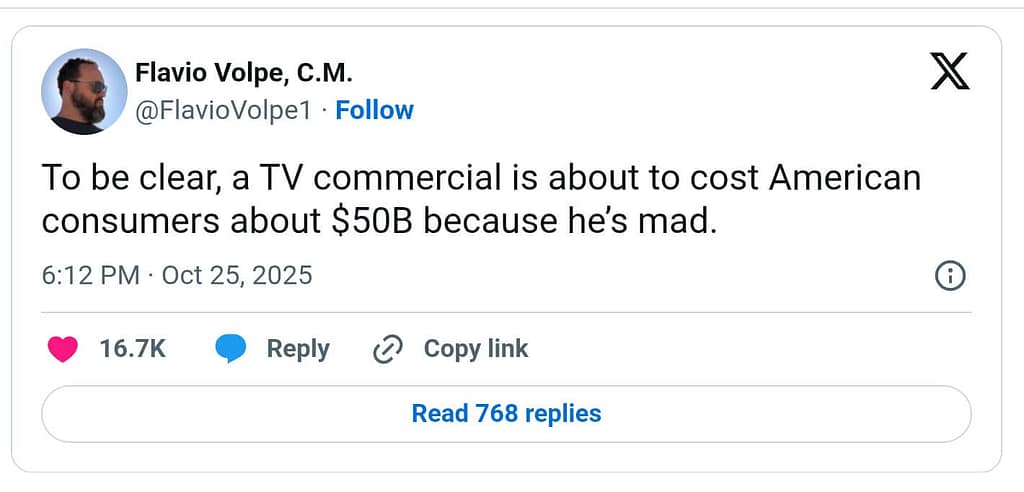
“To be clear, a TV commercial is about to cost American consumers about $50B because he’s mad,” Volpe mentioned on X.
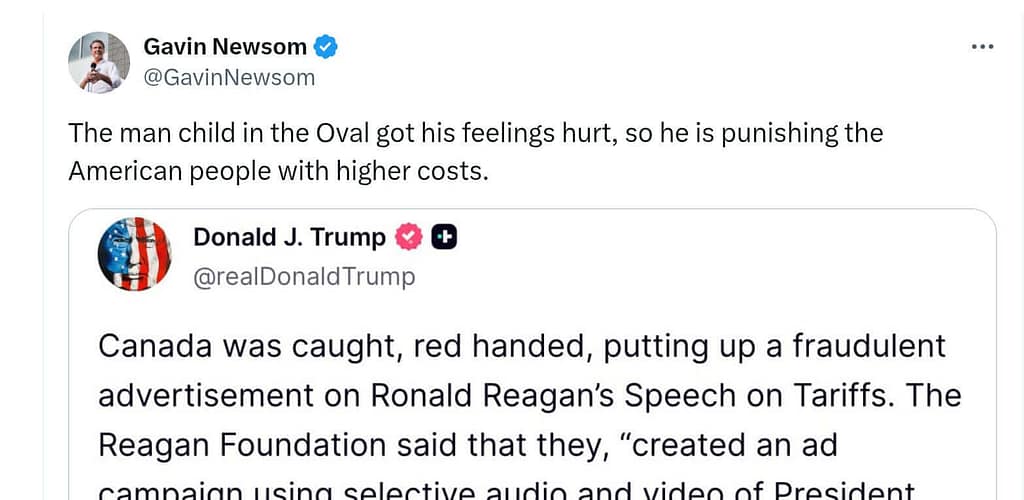
Trump’s tariffs have hit the auto sector of Canada particularly hard. California Gov. Gavin Newsom, who has a public feud with Trump, said that the tariffs would cost the United States more, accusing Trump of “punishing the American people with higher costs” because he “got his feelings hurt.”
The ad showcases footage of former President Ronald Reagan urging against the economic consequences of tariffs. It was also shown once more during the World Series broadcast on Friday night, where the Toronto Blue Jays defeated the Los Angeles Dodgers.
Upon leaving the White House for Asia on Friday night, Trump called the ad ‘crooked’ and ‘possibly AI’.
He asserted that it misrepresented Reagan’s position, a two-term president and beloved figure in the Republican party. However, Reagan was cautious about tariffs and used much of the 1987 speech featured in Ontario’s ad to explain the opposition to tariffs.
The New York Times analysis of the ad and the original speech, which was published on Saturday, revealed that even though it reordered some of the parts of the 1987 speech, it didn’t misrepresent or alter what Reagan said.
The ads have been running on right-wing networks that target Republican and Trump supporters, like Newsmax and Fox News, since last week.
Trump has expressed concern that the ad was designed to influence the U.S. Supreme Court ahead of next month’s arguments that could determine whether Trump has the authority to impose his sweeping tariffs, which are a significant part of his economic strategy.
During the launch of the ads, Ford stated that he planned to repeat Reagan’s anti-tariff message to “every Republican district there is right across the entire country.”
The ads were intended to start a discussion about the kind of economy Americans want and the effects of tariffs on workers and businesses, as Ford stated on Friday.
“We’ve achieved our goal, having reached U.S. audiences at the highest levels,” according to a media statement by Ford on Friday.